
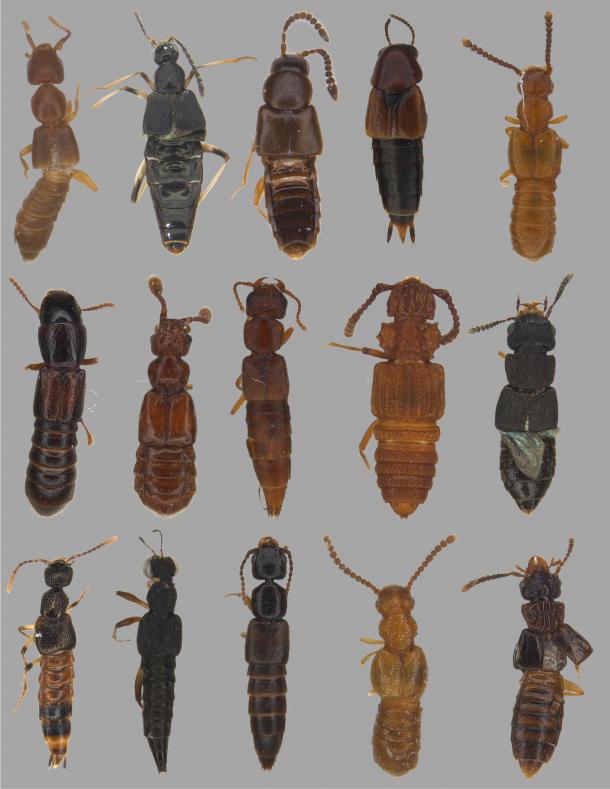
Rove beetles from Volcan Cacao, in ACG. Photo courtesy of Alex Smith.
New PNAS study from Área de Conservación Guanacaste reveals how climate change may threaten one of the world's richest insect communities
What happens when the climate changes faster than species can adapt?
A new study published in the Proceedings of the National Academy of Sciences (PNAS) suggests that many tropical insects may face exactly that challenge.
Researchers working in Costa Rica's Área de Conservación Guanacaste (ACG) found that insects living in the cool cloud forests of Volcán Cacao have evolved to thrive within a remarkably narrow range of temperatures. As the climate warms, these species may have little ability to cope with hotter conditions moving upslope.
At the same time, insects living in the hot lowland forests appear to already be living close to their upper heat limits.
Together, the findings paint a concerning picture: species at both ends of the mountain may be vulnerable to climate change, but for different reasons.
A Natural Laboratory for Climate Change
Few places on Earth offer the opportunity to study climate change the way ACG does.
Within a distance of just a few dozen kilometers, the protected landscape rises from tropical dry forest near sea level through rain forest to cool cloud forest at the summit of Volcán Cacao. This steep elevational gradient allows scientists to compare how closely related species respond to very different temperatures while living within the same protected ecosystem.
For this study, researchers examined more than 100 species of rove beetles collected from eight elevations along the volcano.
Rove beetles are one of the most diverse groups of animals on Earth, with more than 60,000 described species—and many thousands more still awaiting discovery.
By carefully measuring how much heat and cold individual beetles could tolerate, the researchers were able to ask an increasingly urgent question:
How prepared are tropical insects for a warming world?
Testing a Classic Idea in Tropical Ecology
The study also revisits one of the most influential ideas in tropical biology.
Nearly 60 years ago, Dr. Daniel Janzen proposed that tropical mountain species evolve narrower temperature tolerances because they experience relatively stable climates. Unlike species in temperate regions, they rarely encounter large seasonal temperature swings.
That means even modest increases in temperature may present significant challenges.
The new research provides strong support for Janzen's original hypothesis.
Cloud forest beetles—the insects living in the coolest and most stable environments—showed the narrowest thermal tolerances and the least ability to withstand higher temperatures.
Meanwhile, beetles living in the lowlands were better able to tolerate heat, but field measurements revealed they already experience temperatures close to their physiological limits.
"The insects at lower elevations may already be living very close to their limits, while the insects higher on the mountain are not built for the temperatures that are coming toward them," said Dr. M. Alex Smith, the study's corresponding author and a GDFCF Board Member. "Moving upslope may help some species temporarily beat the heat. But most of these species do not move much; and eventually, there will be nowhere higher to go."
Decades of Research Made This Possible
Like many of ACG's most important scientific discoveries, this study did not happen overnight.
It builds upon decades of biodiversity inventory begun by Dr. Daniel Janzen and Dr. Winnie Hallwachs (also authors of this paper), the extraordinary work of ACG's parataxonomists, and the long-term protection of one of the world's most biologically important landscapes.
Since 2013, researchers have recorded temperatures every 15 minutes from sea level to the summit of Volcán Cacao, creating one of the most detailed records of how climate varies across a tropical mountain.
The project also draws upon nearly two decades of rove beetle collections, DNA barcoding, and biodiversity inventory.
Because only about one percent of the rove beetle species found on Volcán Cacao currently have scientific names, DNA barcoding was essential for distinguishing species and understanding how each responds to temperature.
The study demonstrates the extraordinary value of long-term conservation and scientific investment. Without protected forests, patient biodiversity inventory, and decades of continuous research, questions like these simply could not be answered.
Why It Matters
Climate change is often discussed in terms of forests, glaciers, or coral reefs.
But the vast majority of Earth's biodiversity is made up of small organisms like insects—and we still know remarkably little about how most species will respond as temperatures continue to rise.
Studies like this help scientists move beyond broad predictions to understand how individual species experience environmental change.
"Trying to predict the future of biodiversity using only a fraction of the species that actually exist is like trying to assemble new furniture without all the pieces—or the Allen key," said Smith. "ACG gives us an extraordinary opportunity to begin filling in those missing pieces."
As climate change accelerates, understanding how biodiversity responds may prove just as important as discovering biodiversity itself.
Read the paper

Study authors Dr. Alex Smith and Dr. Alexandre M. M. C. Loureiro, en route to the summit of Volcan Cacao. Photo by Alex Smith.