
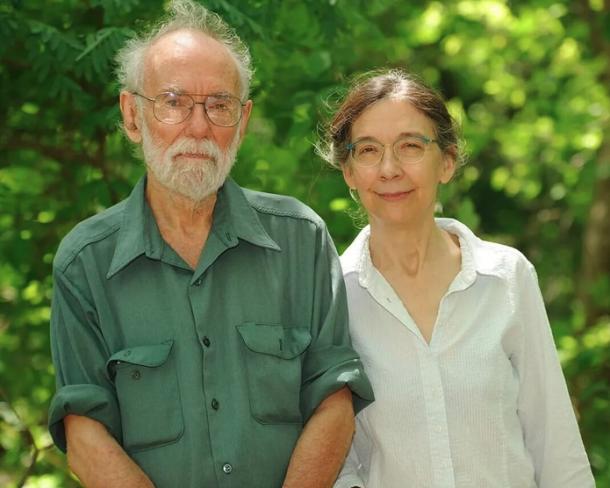
Dan and Winnie. Photo courtesy of the Blue Planet Prize.
A new feature by Mongabay founder Rhett Ayers Butler tells the remarkable story of Dan Janzen, Winnie Hallwachs, and the many people who have spent decades restoring, protecting, and learning from Área de Conservación Guanacaste.
We are delighted to share a wonderful new feature published today by Mongabay: “Daniel Janzen and the long work of bringing back a forest,” by Mongabay founder Rhett Ayers Butler.
The article traces a story that spans more than half a century—from Dan’s early work as a tropical ecologist to the extraordinary experiment in conservation and restoration that ultimately became Área de Conservación Guanacaste (ACG).
It is, in part, the story of bringing a forest back.
Beginning in the 1980s, Dan and Winnie Hallwachs joined with Costa Rican colleagues to pursue what at the time seemed an audacious idea: rather than simply protect the remnants of tropical dry forest that remained in northwestern Costa Rica, create enough protected space for the forest to regenerate—and reconnect that landscape with neighboring ecosystems.
Today, ACG encompasses an extraordinary sweep of protected land and sea, connecting Pacific coastal and marine ecosystems with tropical dry forest, cloud forest, and Caribbean rain forest.
But as Butler's article makes beautifully clear, protecting the land was only the beginning.
The forest had to be defended from fire. Land had to be acquired and incorporated. Biodiversity had to be inventoried and understood. Children from neighboring communities had to be brought into the forest and given the opportunity to experience it firsthand. And conservation needed to become not something imposed from outside, but something embedded in the region itself.
That has taken decades—and thousands of people.
ACG's parataxonomists, educators, firefighters, field staff, administrators, scientists, neighboring communities, government leaders, donors, and partners have all contributed to making this experiment endure. Many of the people who began this work decades ago trained others who now carry it forward.
And the science continues.
The painstaking biodiversity inventory that began with people walking through the forest, collecting caterpillars, recording host plants, and rearing insects has evolved alongside new tools such as DNA barcoding. The result is an extraordinary body of biological information that continues to generate discoveries and challenge assumptions about how much life exists on Earth.
That is perhaps what makes this story so powerful to us. ACG is often described as a conservation success story, but “success” can make something sound finished.
This isn't.
The forest continues to regenerate. Fire remains an ever-present threat. Species remain to be discovered and understood. New generations of Costa Ricans are taking on the work. And the enormous biological library protected within ACG has only begun to reveal what it can teach us.
For nearly four decades, GDFCF has had the extraordinary privilege of helping support that work—and the people who make it possible.
We are deeply grateful to Rhett Ayers Butler and Mongabay for taking the time to understand this remarkable story and for telling it so beautifully.
Read the full Mongabay feature: Daniel Janzen and the long work of bringing back a forest