Three Major Scientific Publications in One Month Highlight the Global Impact of ACG Research
In just over a month, research conducted in and around Área de Conservación Guanacaste (ACG) has been featured in three major peer-reviewed scientific journals, underscoring the extraordinary scientific value of one of the world's most biodiverse protected areas.
The latest publication, appearing in the journal Genome, presents the most comprehensive DNA barcode-based inventory of insects ever assembled for Costa Rica. It follows two groundbreaking papers published in Proceedings of the National Academy of Sciences (PNAS), together highlighting the global significance of ACG's long-term commitment to biodiversity inventory, conservation, and scientific research.
Mapping the Hidden Diversity of Costa Rica's Insects
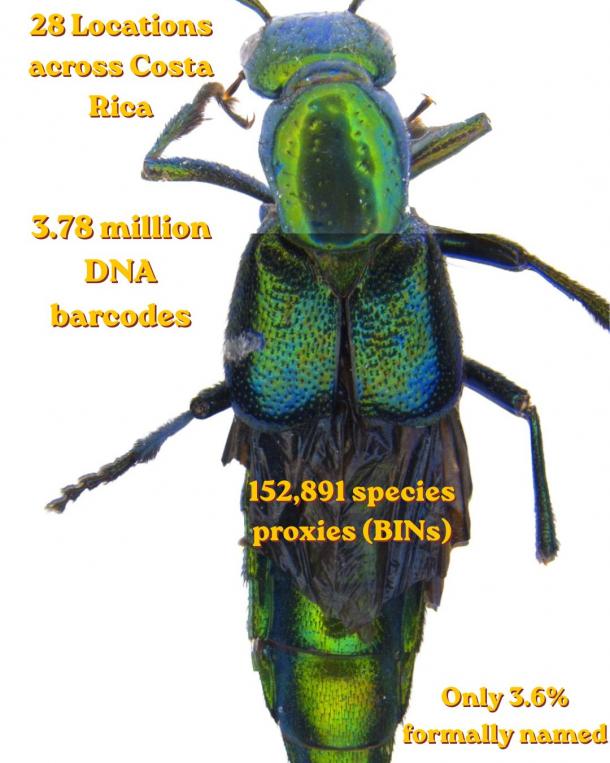
The new Genome paper analyzed 3.78 million DNA barcodes representing 152,891 Barcode Index Numbers (BINs)—species proxies—from 28 locations across Costa Rica. Remarkably, only 3.6% of these have been formally described and assigned scientific names, illustrating just how much of the country's insect diversity remains unknown to science.
Rather than finding one continuous insect community across the country, researchers discovered that Costa Rica is composed of distinct insect assemblages, shaped by mountains, elevation, rainfall, and ecosystem type. Many insect species occur in only a single region—or even a single locality—demonstrating that each ecosystem harbors its own unique biodiversity.
These findings reinforce an important conservation message: protecting biodiversity requires conserving a diversity of ecosystems, from tropical dry forests and rainforests to cloud forests and high-elevation habitats.
Decades in the Making
Although this publication is new, the work behind it spans decades.
The research builds upon the long-term biodiversity inventory pioneered by Drs. Daniel Janzen and Winnie Hallwachs and made possible through the tireless efforts of the parataxonomist team, researchers, taxonomists, students, and institutional collaborators. Millions of specimens collected in the field, combined with DNA barcoding technology, are helping scientists uncover patterns of biodiversity that would have been impossible to detect using traditional methods alone.
Every specimen collected, every caterpillar reared, every Malaise trap serviced, and every DNA barcode generated contributes to a growing understanding of one of Earth's richest ecosystems.
A Remarkable Month for ACG Science
The Genome publication marks the third major scientific paper published from ACG research in approximately one month.
The first PNAS paper fundamentally reshaped our understanding of global insect diversity by demonstrating that Earth likely harbors far more insect species than previously estimated.
The second PNAS publication examined how tropical rove beetles respond to temperature across elevations, providing important insights into the vulnerability of tropical mountain biodiversity under climate change.
Now, the Genome paper reveals how Costa Rica's insect diversity is organized across landscapes and ecosystems, providing an invaluable framework for biodiversity monitoring and conservation planning.
Together, these three publications demonstrate the extraordinary scientific value of long-term conservation. They also illustrate why ACG has become an internationally recognized living laboratory—where protecting biodiversity and studying it go hand in hand.
We extend our congratulations to all of the authors, collaborators, parataxonomists, and institutions whose dedication continues to advance our understanding of life on Earth.