
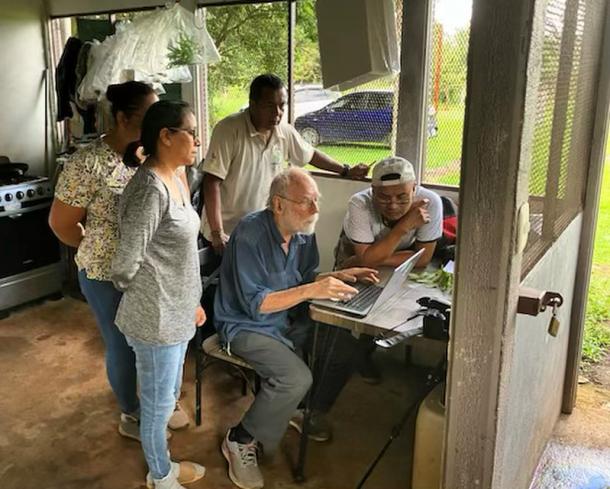
Dan with parataxonomists Lucía Rios, Elieth Cantillano, Osvaldo Espinosa, and Roster Moraga. Estación Los Almendros. Photo by Eric Palola.
Decades of Discovery in Área de Conservación Guanacaste Reshape Our Understanding of Life on Earth
New PNAS study suggests Earth may harbor 14–30 million insect species
For more than 30 years, scientists, parataxonomists, and field biologists working in Área de Conservación Guanacaste (ACG) have been documenting one of the richest ecosystems on Earth. Today, that extraordinary effort has culminated in a scientific milestone with global implications.
A new study published on June 29, 2026 in the Proceedings of the National Academy of Sciences (PNAS) suggests that Earth may harbor between 14 and 30 million insect species—far more than the long-standing estimate of approximately six million.
The research is rooted directly in decades of biodiversity inventory carried out in ACG.
Using more than 1.6 million DNA-barcoded insects representing nearly 54,000 species, the international team of scientists developed a new approach to estimating global insect diversity. Their findings suggest that scientists have only begun to describe the vast majority of insect life on our planet.
Perhaps most remarkably, the authors (which include Dan, Winnie, Frank Joyce, Alex Smith, and Rob Puschendorf) estimate that between 93% and 97% of the world's insect species still do not have scientific names.
A Vision More Than Three Decades in the Making
This publication represents much more than a single scientific paper.
It is the culmination of a vision begun by Dr. Daniel Janzen and Dr. Winnie Hallwachs more than three decades ago: that long-term conservation, coupled with meticulous biodiversity inventory, could transform our understanding of the natural world.
That vision inspired the creation of one of the most comprehensive biodiversity inventories ever undertaken.
Thousands upon thousands of caterpillars were reared. Millions of insects were collected through Malaise trapping. DNA barcoding revolutionized species identification. Taxonomists around the world collaborated to identify species. Throughout it all, ACG's remarkable parataxonomists provided the field expertise, dedication, and continuity that made this work possible.
The result is a scientific resource unlike any other.
Why ACG?
The question naturally arises: why could this study only have been done here?
Área de Conservación Guanacaste combines extraordinary biological richness with an equally extraordinary commitment to long-term research and conservation. Dry forest, cloud forest, and rainforest ecosystems exist within a single protected landscape, allowing scientists to study biodiversity across multiple habitats.
Just as important is the continuity of the work. Decades of consistent sampling, careful record keeping, DNA barcoding, and collaboration between Costa Rican and international scientists created a dataset that simply does not exist anywhere else in the world.
A Tribute to the People Behind the Science
While the paper presents groundbreaking scientific findings, it is also a tribute to the people who made those discoveries possible.
The publication recognizes the contributions of ACG's parataxonomists, whose unparalleled knowledge of the forests has helped reveal countless new species over the past three decades. It reflects the dedication of taxonomists, students, technicians, and researchers from around the world, all working together toward a common goal.
It is also a testament to Costa Rica's enduring commitment to conservation and to the value of protecting biodiversity—not only for its own sake, but because every new discovery deepens our understanding of life on Earth.
Looking Forward
The study's conclusion is both humbling and inspiring.
Even after decades of research in one of the world's best-studied tropical ecosystems, scientists believe that the overwhelming majority of insect species remain unnamed.
There is still so much left to discover.
At GDFCF, we are proud to support the long-term conservation, research, and biodiversity inventory that made this landmark publication possible. We are deeply grateful to the donors, partners, and friends whose support over many years has helped sustain this work.
Today's publication reminds us that some of the world's most important scientific discoveries cannot be rushed. They require patience, perseverance, collaboration—and a belief that understanding nature begins by taking the time to know it.
Read the paper here.
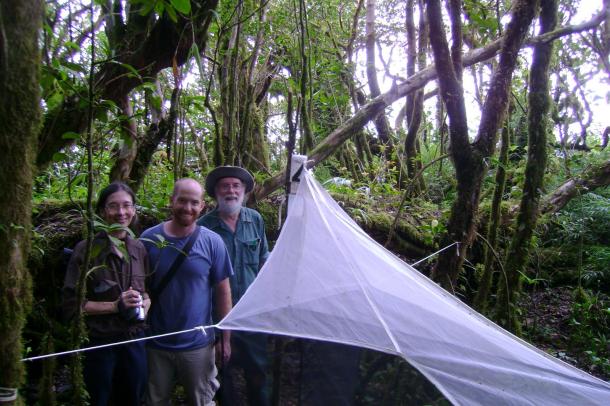
Authors Winnie, Alex Smith, and Dan at a Malaise Trip near Estación Cacao.