
Image created by Alex Smith.
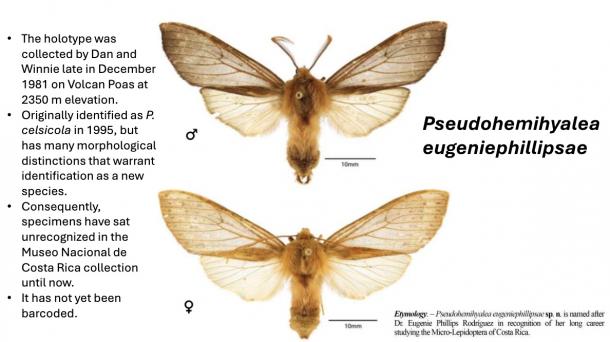
Meet Pseudohemihyalea eugeniephillipsae — a newly described Costa Rican moth with a story more than four decades in the making.
The specimen that would eventually become the holotype of P. eugeniephillipsae was collected by Dan Janzen and Winnie Hallwachs in December 1981, high on Volcán Poás at 2,350 meters elevation. It was later identified as another species and remained, unrecognized for what it truly was, in the collection of the Museo Nacional de Costa Rica for decades.
Now, more than 40 years after it was collected, taxonomic work by Guanacaste Dry Forest Conservation Fund (GDFCF) and Bosque y Mar taxonomist Bernardo A. Espinoza and colleagues has revealed it to be a species new to science.
And its new name could not be more fitting.
Pseudohemihyalea eugeniephillipsae was named in honor of Dr. Eugenie “Jenny” Phillips Rodríguez, GDFCF Associate Science Advisor, in recognition of her long career studying the Micro-Lepidoptera of Costa Rica.
For Jenny, who has spent decades helping to discover, study, identify, and understand Costa Rica’s remarkable insect biodiversity, having a species become eugeniephillipsae feels wonderfully full circle. Her work has contributed to the painstaking process of turning specimens into knowledge—and revealing just how much biodiversity is still waiting to be recognized.
The new species is one of nine described in a newly published revision of Costa Rica’s Pseudohemihyalea moths. The research found the group to be considerably more diverse than previously understood, particularly in Costa Rica’s vulnerable high-elevation ecosystems.
A moth collected in 1981, hiding in plain sight in a museum collection for decades, finally has its own name. And we are delighted that name honors Jenny.