
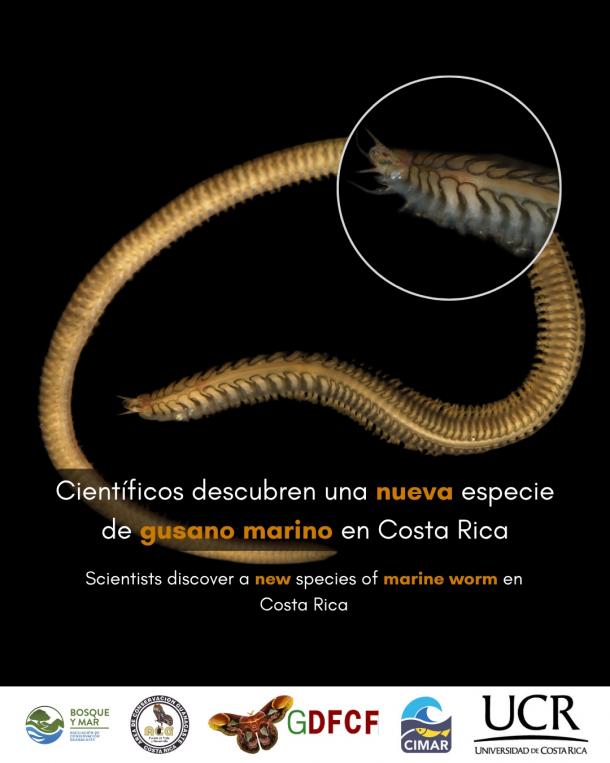
The new worm, Sthenelais onca. Image by Dr. Jeffrey Sibaja-Cordero.
The ocean continues to remind us how much there is still left to discover.
Researchers working with the BioMar program — a collaborative marine biodiversity initiative led by ACG, GDFCF, CIMAR-UCR, and Bosque y Mar — recently described a new species of marine worm found along the Pacific coast of Costa Rica. The species, Sthenelais onca, was discovered by BioMar Project Lead Dr. Jeffrey Sibaja-Cordero, UCR students, and GDFCF marine parataxonomists on sandy beaches in and around Área de Conservación Guanacaste (ACG).
While small and easily overlooked, discoveries like this are an important reminder that even relatively accessible coastal habitats still contain species unknown to science.
The newly described worm belongs to a group called scale worms, marine annelids that live buried in sand and play a role in coastal ecosystems. The researchers chose the name onca — meaning jaguar — in recognition of ACG’s iconic jaguars and because its unique coloration pattern is reminiscent of a jaguar's coat.
BioMar was created to better understand and document marine biodiversity in ACG’s protected waters. Although ACG is internationally known for its tropical dry forest restoration and terrestrial biodiversity inventory, its marine ecosystems remain far less studied. Over the past decade plus, BioMar researchers, marine parataxonomists, students, and collaborators have been conducting underwater surveys, collecting specimens, documenting species distributions, and helping build one of the most comprehensive marine biodiversity inventories in the Eastern Tropical Pacific.
New species discoveries are only one part of that work. Each finding helps strengthen scientific understanding of marine ecosystems while also informing long-term conservation and management efforts in ACG’s marine protected areas.
And perhaps most exciting of all: discoveries like this suggest there is still much more waiting to be found.
For those interested in the technical publication, the paper was published in the journal ZooKeys.